
If you run a roofing company, plumbing business, electrical service, or any home renovation company in the United States, you already know how fierce the competition is online. You might spend money on ads, post on social media, and even do some basic SEO. But here is the thing most business owners miss right now: the way people search for services has fundamentally changed. People no longer just type keywords into Google. They ask questions out loud to Siri, type full sentences into ChatGPT, and get direct answers without ever clicking a single link.
So, how does answer engine optimization work, and why should you care? Understanding it could be the single most important thing you do for your business this year.
Understanding Answer Engine Optimization (AEO)
What Is Answer Engine Optimization?
How does answer engine optimization work at its core? It is the process of optimizing your online content so that AI-powered platforms, voice assistants, and search engines can pull your information and present it as a direct answer to a user’s question. Instead of your website just showing up as a blue link in Google, your content becomes the actual answer. It gets read aloud, displayed in a summary box, or cited inside a tool like ChatGPT or Google’s AI Overview.
As Semrush explains, AEO is a set of marketing practices used to increase a brand’s visibility in AI-generated answers, such as Google’s AI Mode and ChatGPT responses. It is not about stuffing keywords anymore. It is about being the most trusted, clearest, and most structured source of information on a topic that matters to your customers.
For a roofing contractor in Houston or an electrician in Chicago, this means that when someone asks their phone, “Who is the best roofer near me?” or types into ChatGPT, “How much does a roof replacement cost in Atlanta?”, your business could be the answer that comes back.
The Importance of AEO in Modern Search
Here is a number that should make every small business owner pay attention: zero-click searches went from 56% of all Google searches in 2024 to 69% in 2025. More than two-thirds of people searching on Google now get their answers directly on the results page. They never visit a website.
At the same time, ChatGPT now serves 800 million users every week. Voice assistants answer questions on smartphones, smart speakers, and even cars. The entire landscape of how customers find service businesses has shifted.
According to research, companies that put how does answer engine optimization work into practice early in 2024 now see 3.4 times more visibility in AI-generated responses compared to competitors who waited. For a plumber in Miami or a home renovation company in New York, that visibility difference translates directly into more phone calls and more booked jobs.
The business impact is real. NerdWallet grew its revenue more than 35% in 2024 while its monthly website traffic decreased by 20%. That trend shows that users are not shopping less. They are discovering and deciding through AI tools instead of clicking through websites.
The Difference Between SEO and AEO
A lot of business owners ask me this question every week. Traditional SEO and AEO are not the same thing, but they work together.
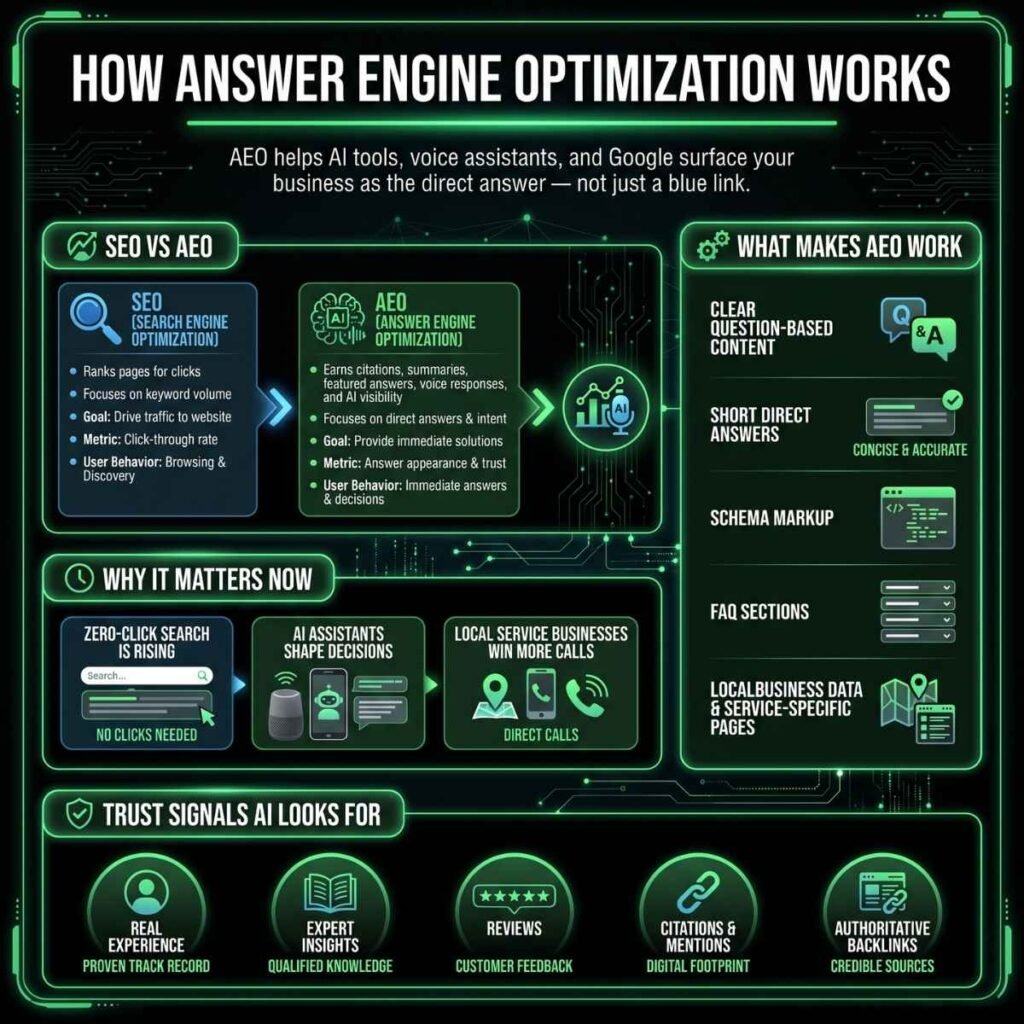
Traditional SEO ranks your web pages in Google’s search results so people click through to your website. You optimize for keywords, build backlinks, and make sure your site loads fast. Success is measured by rankings, clicks, and traffic.
AEO makes your content the direct answer inside AI tools. The goal is not just a click. It is a citation. It is your business name getting mentioned when someone asks an AI assistant for a recommendation. AEO aligns your content, technical markup, and authority signals so that AI systems select you as the source in their responses.
Here is a quick comparison:
Traditional SEO: Rank in search results, drive clicks to your website, target keywords, and measure rankings and traffic.
AEO: Get cited in AI-generated answers, appear in featured snippets and voice search results, target question-based queries, and measure brand mentions and AI citations.
Much of what you already do for SEO also helps with AEO. But AEO requires additional steps around how you structure content and present your business information.
Benefits of Implementing AEO for Local Service Businesses
For a roofer, electrician, plumber, or home renovation contractor, AEO delivers several concrete benefits.
You show up in voice search. When a homeowner asks their Google Hom,e “Who fixes leaky pipes in Chicago?”, AEO-optimized content puts your business in the answer. There are around 8.4 billion digital voice assistants in use globally, and that number keeps growing.
You build brand authority before anyone clicks. Even in a zero-click world, your business name gets associated with expertise and trust. That brand recognition leads to direct phone calls or searches for your company name later.
You reach customers earlier in their decision. By appearing in direct answers to high-intent questions, you capture customers before they even open a competitor’s website.
You get a competitive edge over local contractors. Most local service businesses have not yet invested in AEO. The opportunity to dominate AI-generated local answers is wide open right now.
Challenges in Answer Engine Optimization
AEO is not a set-it-and-forget-it strategy. Here are a few honest challenges worth knowing:
AI models update frequently. What gets cited today may need refreshing next month. Unlike traditional SEO rankings that hold for months, AEO signals can shift as engines update.
Measuring success is harder than with traditional SEO. You cannot log into Google Analytics and see an “AEO Traffic” column. You need new tools and new thinking.
Content needs a specific structure. AI systems look for clear, authoritative, machine-readable answers. Vague or disorganized website content will not make the cut.
Despite these challenges, businesses that master how does answer engine optimization works today will own local search results for years to come.
How to Implement Answer Engine Optimization
Keyword Research for AEO
Traditional keyword research focuses on short terms like “roof repair Houston.” AEO keyword research goes further. It focuses on the actual questions your customers ask out loud.
Think about how someone talks when they need a service. They do not say “roof repair Houston.” They sa,y “How much does it cost to repair a roof in Houston?” or “Who is the best roofer in my area?” or “What should I do if my roof is leaking?”
How to Find AEO Keywords
For AEO, identify question-based, conversational queries for your specific trade and location. Tools like AnswerThePublic, Google’s People Also Ask section, and search suggestions that appear as you type in Google are excellent sources.
Once you have your question list, build your content around directly answering those questions. Each page or section of your website should target one clear question. Provide a concise, authoritative answer first, then support it with detail.
Structuring Content for Featured Snippets
Featured snippets are the highlighted answer boxes that appear at the top of Google’s search results. Getting your content into a featured snippet is one of the clearest signs that how does answer engine optimization works is working for your site. Featured snippets also feed into how AI Overviews and other AI tools select their answers.
To structure content for featured snippets, follow these steps:
Use question-format headings. Instead of “Roof Replacement Costs,” use “How Much Does a Roof Replacement Cost in the United States?”
Write a direct answer of 40 to 60 words right after each question heading. This is the answer capsule that AI systems lift and cite. Then go deeper with supporting details below.
Use numbered lists and step-by-step instructions. Lists are among the easiest formats for AI systems to assemble and quote. If you explain “How do I know if I need a new roof?”, break it into clea,r numbered steps.
Use comparison tables when comparing services, pricing tiers, or options. These formats work well for AI tools like Perplexity and Bing Copilot.
Keep paragraphs short and focused. One clear point per paragraph. Short paragraphs are far more likely to become the source of an AI-generated answer.
Leveraging Schema Markup for AEO
Schema markup is the technical side of how does answer engine optimization works. It is one of the most powerful tools available to local service businesses. Schema is structured data code you add to your website. It acts as a label system that tells search engines and AI tools exactly what your content means.
Without schema markup, a search engine reads your page and guesses at the meaning. With schema markup, you hand AI a perfectly organized inventory of your business information.
Research from 2025 found that pages with the FAQPage schema achieved a 41% citation rate in AI tools, compared to only 15% for pages without it. That is nearly three times the likelihood of getting cited just from adding structured data.
Key Schema Types for Local Service Businesses
Here are the most important schema types to implement:
LocalBusiness Schema is non-negotiable for any contractor or service provider. It tells search engines your exact business name, address, phone number, service area, and hours. Local businesses that use this schema appear in Google Maps results and voice search responses. When someone asks “Hey Google, best electrician near me?”, this schema helps your business show up.
FAQPage Schema marks up any FAQ section on your website. It mirrors how users ask questions in voice search and AI tools. It improves the chances of your content getting cited by AI systems.
Service Schema ties your business to the specific solutions you provide. For each service you offer, create a dedicated page with a Service schema that includes a clear description and your service area.
Article or BlogPosting Schema communicates content freshness and authorship for your blog posts and guides. It feeds directly into how AI tools evaluate your content’s trustworthiness.
A critical rule: schema markup must always reflect what is actually on your page. Never invent information in your structured data. Consistency between your schema and your visible content builds trust with AI systems.
Improving Website Authority for AEO
AI tools do not pick just any source for their answers. They prefer sources that are demonstrably authoritative, trustworthy, and recognized across the web. This is where E-E-A-T comes in: Experience, Expertise, Authoritativeness, and Trustworthiness.
Applying E-E-A-T for Contractors and Service Businesses
For a roofing contractor or plumber trying to win AEO visibility, here is what E-E-A-T looks like in practice:
Experience: Show real work. Include before-and-after photos, case studies of actual jobs you have completed, and testimonials from real customers in specific cities. AI systems increasingly prioritize firsthand practitioner insights when selecting answers.
Expertise: Have dedicated pages about your certifications, licenses, years in business, and areas of specialty. For a roofing company, mention specific roofing systems you install. For an electrician, list your licensing details.
Authoritativeness: Get mentioned in local news, industry directories, and reputable websites. Links and mentions from trusted sources signal to AI that you are a recognized authority. Contributing to relevant community discussions, such as local Reddit threads or home improvement forums, also helps since AI tools like Perplexity and Google pull heavily from Reddit content.
Trustworthiness: Keep all your business information consistent everywhere it appears online. Your name, address, and phone number should be identical on your website, Google Business Profile, Yelp, Angi, and every directory. Inconsistencies erode trust signals. Also, make sure your website uses HTTPS, loads fast on mobile, and is easy to navigate.
Tools and Resources for Answer Engine Optimization
As you begin learning how does answer engine optimization work for your own business, these tools will help you track progress and refine your strategy:
Google Search Console is your starting point. It shows which queries drive traffic to your site and where you appear in featured snippets.
Semrush AI Monitoring tracks how often your brand appears in AI-generated answers across Google AI Overviews and ChatGPT.
AnswerThePublic helps you discover the questions your target customers ask, organized by topic and question type.
Google’s Rich Results Test validates your schema markup and confirms it is correctly set up.
Manual AI Testing is something I recommend to every client. Create a list of 10 to 20 high-intent questions that your customers would ask. Test them monthly in ChatGPT, Gemini, and Perplexity. Document how often your business gets mentioned and what language AI uses to describe you.
Measuring the Success of Answer Engine Optimization
Key Metrics for AEO Success
Here is where AEO differs most from traditional SEO. You cannot measure success purely by keyword rankings or organic traffic numbers alone. You need a broader set of signals.
The primary metrics for AEO success include:
AI Citation Rate: How often does your brand or content get cited in AI-generated answers? Track this manually by testing relevant prompts in AI tools each month.
Featured Snippet Acquisition: Monitor how many featured snippets your pages hold in Google. Featured snippets predict AEO success because content that earns snippets also tends to get cited in AI Overviews.
Brand Visibility in AI Answers: When your business appears in AI responses, where does it appear? Brands appearing in the first one to two sentences of AI responses see 22% higher brand recall than those appearing later.
Zero-Click Impression Data: Using Google Search Console, track impressions even when clicks do not occur. High impressions with low clicks can indicate AEO success. People see your brand name in answer boxes without clicking through.
Analyzing Traffic from Voice Search
Voice search traffic is hard to track precisely, but practical methods exist. In Google Search Console, look at the Performance report and filter for long-tail, conversational queries. Phrases like “how to,” “what is,” “best way to,” “near me,” and “who can” are strong indicators of voice-driven searches.
What Voice Search Data Tells You
Monitor improvements in long-tail keyword performance over time. A steady increase in visibility for conversational, question-based queries suggests your AEO content strategy is working.
Also pay attention to your Google Business Profile insights. Calls and direction requests that spike without a matching increase in organic website traffic can mean that voice search and AI tools are sending people directly to your phone number. They are not visiting your website first.
Monitoring Featured Snippet Rankings
Use Semrush’s Position Tracking tool to monitor which of your pages hold featured snippet positions. Set up weekly tracking for your most important question-based keywords.
When you win a snippet, study the format that earned it. Was it a paragraph answer, a numbered list, or a table? Use that insight to optimize other pages in the same format.
When you lose a snippet to a competitor, analyze their content. What did they do differently? How is their answer structured? Use those observations to improve your own content.
Evaluating User Engagement and Behavior
Even in an AI-driven search landscape, engagement metrics remain important indicators of content quality. Track time on page, scroll depth, and bounce rate for pages targeting question-based queries.
Content that answers a question well should keep users on the page long enough to read the full answer. If users land on your page and immediately leave, your content is not answering what they came for.
Also look at goal completions in Google Analytics 4: phone calls, form submissions, and booking requests from users who arrived via organic search. AEO is ultimately about getting more calls and customers, and this is where you connect visibility to real revenue.
Case Studies: Successful AEO Strategies
What the Data Shows About AEO Results
The data across industries consistently shows that AEO produces real business results when executed correctly.
Research across AI platforms found that entity-driven content improved AI citation likelihood by more than 35% across major generative search platforms. Businesses that clearly define what they do, who they serve, and where they operate are getting far more AI citations than businesses with vague or generic website copy.
The NerdWallet Example
One of the clearest real-world examples of how does answer engine optimization work in practice comes from NerdWallet. The company grew revenue 35% in 2024 while website traffic fell 20%. Users discovered and made decisions through AI tools rather than traditional website visits. Businesses visible in those AI tools still captured the customer even without a click.
The Formula That Works for Local Service Businesses
For local contractors, the formula that drives AEO results involves four elements: a fully optimized Google Business Profile with consistent NAP information, service pages with LocalBusiness and Service schema markup, FAQ sections targeting the exact questions customers ask before hiring a contractor, and educational content like guides and how-to articles that establish expertise and earn citations.
Results for Home Service Businesses
When I work with roofing contractors and home service businesses across Houston, Chicago, New York, Miami, and Atlanta, the results follow a consistent pattern. Within 60 to 90 days of implementing this approach, businesses start appearing in featured snippets, AI Overviews, and local voice search results for their core service queries.
The key insight is this: how does answer engine optimization work is not just a theoretical question. It is a practical strategy that delivers measurable results for local businesses willing to invest in it today.
Frequently Asked Questions About Answer Engine Optimization
Traditional SEO focuses on ranking web pages in search engine results to drive clicks to your website. AEO focuses on making your content the direct answer inside AI-generated responses, featured snippets, and voice search results. Both strategies share many best practices, but AEO requires additional steps like structured data markup, question-format content, and entity optimization. Most businesses should invest in both, since they work together and serve different but complementary goals.
Most businesses begin seeing improvements in featured snippet appearances and AI citation rates within 60 to 90 days of implementing a solid AEO strategy. This includes proper schema markup, question-based content restructuring, and consistent business information across platforms. AEO requires ongoing attention because AI models update frequently, and content that earns citations today needs to stay fresh and accurate to maintain its position.
Absolutely. For local service businesses, AEO is one of the highest-impact investments you can make right now. Voice search queries for local services have exploded as smart speaker and mobile voice assistant use has grown. When a homeowner asks their phone, “Who is a reliable electrician near me?” or “How much does a new roof cost?”, your business needs to be the answer. Local business schema, Google Business Profile optimization, and question-based content targeting local queries are the core pillars of local AEO.
What is schema markup and do I really need it for AEO?
Schema markup is structured data code you add to your website. It helps search engines and AI tools understand what your business does, where you are located, and what your content is about. Research shows that pages with proper FAQ schema achieve a citation rate nearly three times higher in AI tools compared to pages without it. For a local service business, LocalBusiness schema is non-negotiable, and FAQPage schema for your Q&A content is strongly recommended as well.
How do I know if my content is showing up in AI-generated answers?
The most direct way is manual testing. Create a list of 10 to 20 questions your ideal customers might ask about your services, then test those questions monthly in ChatGPT, Google Gemini, Perplexity, and Microsoft Copilot. Note whether your business or website gets cited. You can also use tools like Semrush’s AI Monitoring feature to track brand mentions systematically. Google Search Console also provides impression data for featured snippets, which closely correlate with AI Overview citations.
Final Thoughts: AEO Is the Future of Local Business Visibility
The search landscape has changed more in the past three years than in the previous decade. Voice assistants, AI chatbots, and zero-click search results have changed how customers find and choose local service providers. If you are a roofer, plumber, electrician, or home renovation contractor, the businesses that dominate AI-generated answers in your city over the next few years will be the ones that invest in AEO now.
How does answer engine optimization impact your bottom line? It puts your business in front of customers exactly when they’re asking questions and making decisions. Rather than replacing traditional SEO, it strengthens it by adding a powerful visibility layer. With this approach, your brand can appear across Google Maps, voice search, and AI platforms like ChatGPT, Gemini, and Claude-all at the same time.
Ready to see where your business stands? I offer a free SEO audit for local and small business owners across the United States. Let’s find out exactly what it would take to make your business the answer your next customer gets.